
Truck Accident Evidence to Preserve After a Crash
Secure truck accident evidence to preserve after a crash before it vanishes. Call (833)-670-8160 for a free case review and protect your claim.

By Paxton Ruelle
A truck crash changes everything in a matter of seconds. The roar of metal, the smell of diesel, the confusion that follows, and then the slow realization that your injuries may affect the rest of your life. In the chaotic hours and days after a collision with a commercial truck, most people focus on medical care, which is exactly right. But there is another clock ticking silently in the background, and it controls whether you can prove what happened. That clock governs the truck accident evidence to preserve after a crash, and it starts running the moment the collision occurs. Critical data stored in the truck's electronic systems can be overwritten or deleted. Driver logs can be altered. Witnesses move on. If you do not take deliberate steps to secure this evidence quickly, you may find yourself facing a well-funded trucking company with a legal team that has already locked down its defense.
This guide explains what evidence matters most after a truck crash, why it disappears so fast, and what you can do to protect it. The information here is educational and is not legal advice. For your specific situation, you should speak with a qualified attorney who handles commercial vehicle collisions. If you are unsure where to start, you can request a free, confidential case review through AutoInjuryAccident to speak with a participating attorney about your options.
Why Evidence in Truck Accident Cases Disappears So Fast
Trucking companies are sophisticated businesses. They employ safety directors, risk managers, and legal teams who understand the value of evidence. When a crash occurs, the carrier's first call is often to its insurer and its lawyer, not to the family of the injured driver. Within hours, the company may send its own investigator to the scene. Within days, the truck's electronic control module may be downloaded and the original data replaced. This is not necessarily illegal, but it means that the injured person who waits too long can lose access to the very information that would prove fault.
Federal regulations require motor carriers to retain certain records for specific periods, but retention is not the same as accessibility. A company may keep driver logs for six months, but if those logs are stored on a server controlled by the carrier, you need a legal mechanism to obtain them before they are purged or altered. The same is true for electronic logging device data, which can be overwritten in as little as 24 hours depending on the system configuration. The simple truth is that evidence preservation in truck accident cases is a race, and the party that moves first usually wins.
Electronic Logging Device Data, Driver Logs, and Hours of Service Records
Since the federal electronic logging device mandate took effect, most commercial trucks are equipped with an ELD that automatically records driving time, engine hours, vehicle movement, and location. This data is gold for accident reconstruction. It can show whether the driver had been on the road too long, whether the truck was speeding, and whether the driver was fatigued. But ELD data is not permanent. Many systems overwrite older data after a short period, and the carrier controls the device. If you do not send a preservation letter quickly, the data may be gone.
Driver logs and hours of service records tell a similar story. A driver may have falsified a log to hide excessive driving hours, and the paper or electronic record is the only proof. The carrier is required to keep these records, but they can be altered or lost. Your attorney should demand the driver's logs for the day of the crash and the preceding seven days. That window can reveal a pattern of fatigue or rule violations that contributed to the collision.
Here is what you should ask your attorney to preserve immediately:
- ELD data for the truck and driver for the day of the crash and the prior seven days
- Driver logs and hours of service records for the same period
- GPS tracking data and dispatch records showing the driver's route and schedule
- Maintenance and inspection records for the truck and trailer
- Driver qualification files, including training and medical certification
Each of these records can be critical, and each can disappear if not requested in writing. A preservation letter sent to the carrier puts the company on notice that it must not destroy or alter these materials. If the carrier destroys evidence after receiving that letter, the court may impose sanctions, but the damage to your case may already be done.
Preservation Letters: Why They Must Go Out Fast
A preservation letter, sometimes called a spoliation letter, is a formal written demand that a party retain all evidence relevant to a potential lawsuit. It is not a court order, but it creates a legal duty. If the recipient destroys evidence after receiving the letter, the court can punish the destruction with adverse jury instructions, fines, or even dismissal of the defense. The letter should be sent by certified mail and email to the trucking company, its insurer, and any third-party maintenance or leasing company.
Timing is everything. The letter should go out within days of the crash, not weeks. The longer you wait, the greater the chance that the carrier's routine data retention policies will wipe out the evidence. A preservation letter should be specific. It should identify the truck, the driver, the date and location of the crash, and the categories of evidence that must be preserved. A generic letter is better than nothing, but a targeted letter is far more effective.
Your attorney can also seek a temporary restraining order or a court injunction if the carrier refuses to preserve evidence or if there is reason to believe the evidence is being destroyed. This is an extreme step, but it is sometimes necessary. The key takeaway is that preservation letters are not optional in truck accident cases. They are the first line of defense against evidence loss.
Black Box and Telematics Data Held by Carriers
Commercial trucks are equipped with a variety of electronic systems that record performance data. The electronic control module, often called the black box, stores information about speed, braking, engine RPM, and seat belt use in the seconds before and after a crash. Telematics systems transmit real-time data to the carrier, including location, speed, and driver behavior. This data can be used to reconstruct the accident with precision.
The problem is that this data is owned by the carrier. The trucking company may download the data and then clear the device, making it impossible for you to obtain the original. Even if the data is preserved, the carrier may claim that it is proprietary or irrelevant. Your attorney can use the discovery process to compel production, but you need to act quickly to prevent the data from being overwritten.
In many cases, the carrier will hire an accident reconstruction expert who downloads the black box data within hours of the crash. If you do not have your own expert examine the data, you may be at a disadvantage. Your attorney should consider hiring an independent expert to download and preserve the data, or at least to observe the carrier's download to ensure that the data is not altered.
Witness Statements and Scene Documentation in the First 48 Hours
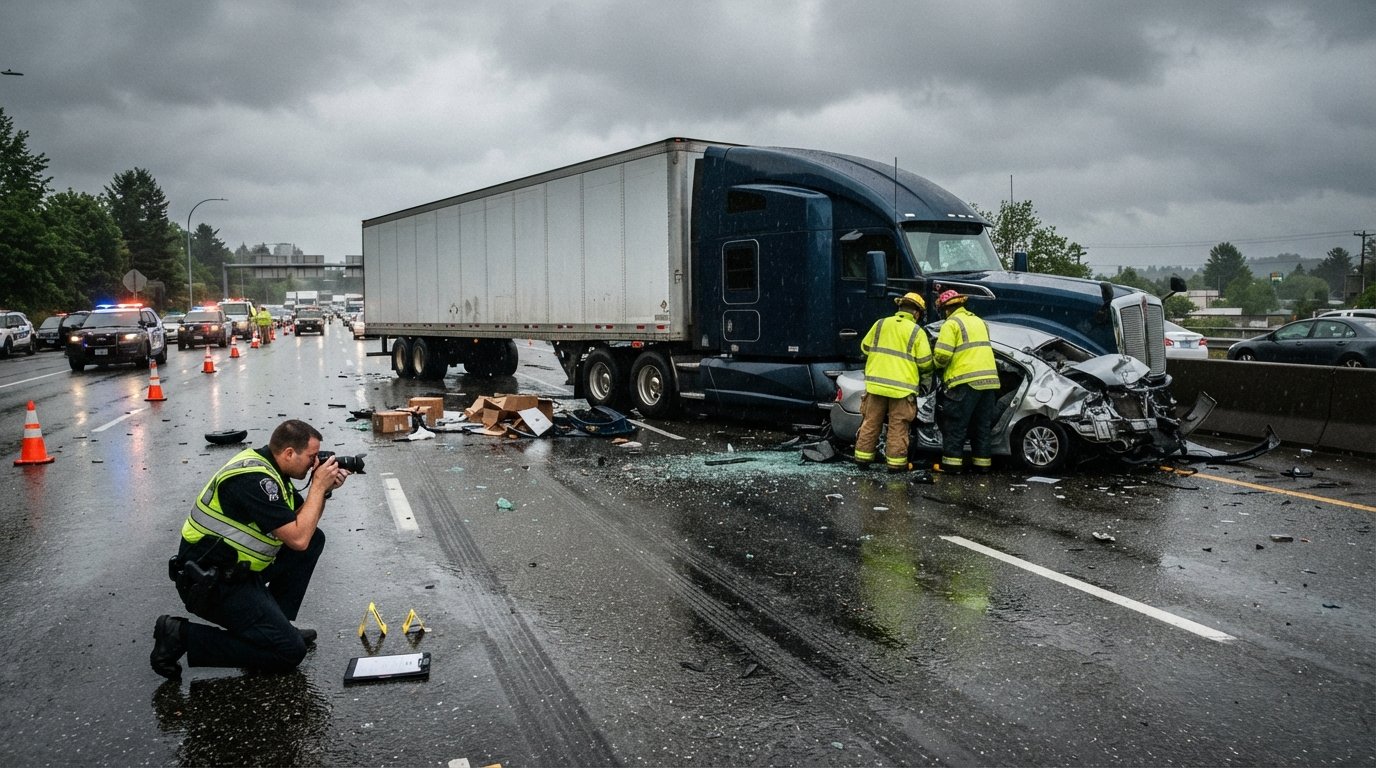
The physical scene of a truck accident is fragile. Skid marks fade, debris is cleared, and road conditions change. Witnesses forget details or move away. The first 48 hours are the most critical window for documenting the scene and collecting witness statements. If you are physically able, take photographs of the vehicles, the road, the weather, and any visible injuries. If you are not able to do so, ask a family member or friend to help.
Witness statements are particularly valuable because they can corroborate your version of events and counter the truck driver's account. Independent witnesses, such as other drivers or pedestrians, are often the most credible. Their contact information should be collected immediately. If the police report does not include witness statements, your attorney can follow up with the responding officers to obtain them.
Here is a checklist for scene documentation:
- Photograph the positions of all vehicles, including damage patterns and license plates.
- Photograph the road surface, including skid marks, gouges, and debris.
- Record the weather and lighting conditions at the time of the crash.
- Collect contact information for all witnesses and the responding police officers.
- Obtain a copy of the police report as soon as it is available.
If you are unable to document the scene yourself, an attorney can hire an investigator to do it for you. The sooner the investigator is on the scene, the better. Some law firms have relationships with accident reconstruction experts who can be dispatched quickly. In our guide on truck accident lawyer San Diego, CA: step-by-step claim guidance, we explain how local attorneys approach evidence preservation and how you can use that process to your advantage.
Why Rapid Legal Involvement Matters Given Federal Trucking Regulations
Federal trucking regulations impose strict requirements on motor carriers. The Federal Motor Carrier Safety Administration sets limits on driving hours, requires drug and alcohol testing after certain crashes, and mandates detailed recordkeeping. These regulations create a paper trail that can be used to prove fault, but they also create deadlines. For example, a post-accident drug and alcohol test must be conducted within a certain number of hours after the crash. If the test is not done on time, the results may be inadmissible or the carrier may argue that there is no evidence of impairment.
Rapid legal involvement ensures that these regulatory deadlines are met and that the evidence is preserved. An attorney who handles truck accident cases knows which records to request, how to phrase a preservation letter, and when to file a lawsuit to compel discovery. Without that involvement, you may lose the ability to obtain critical evidence. The trucking company's legal team is already working; you need someone on your side who understands the rules.
In addition, federal regulations require carriers to maintain accident registers and driver qualification files. These records can reveal a history of safety violations or inadequate training. If the carrier has a pattern of ignoring safety rules, that pattern can support a claim for punitive damages. But the records must be preserved, and the carrier has no incentive to keep them if no one is asking.
How to Build a Preservation Plan After a Truck Crash
Putting together a preservation plan does not have to be complicated, but it does require prompt action. Start by writing down everything you remember about the crash, including the time, weather, and location. Then, contact an attorney as soon as possible. The attorney can send preservation letters, hire experts, and guide you through the process.
If you are unable to hire an attorney immediately, you can send a preservation letter yourself. Address it to the trucking company's safety director and legal department. State that you are a potential claimant and that you demand the preservation of all evidence related to the crash. Keep a copy of the letter and send it by certified mail. This step alone can make a difference.
Remember that evidence preservation is not just about winning a lawsuit. It is about protecting your rights and ensuring that the truth is not buried under a pile of missing records. The trucking company will do everything it can to minimize its liability. You need to do everything you can to preserve the facts.
Finally, do not sign any settlement or release without consulting an attorney. Insurance adjusters may contact you quickly with a low offer, hoping to close the case before you understand the value of your claim. Once you sign, you may lose the right to pursue further compensation. An attorney can evaluate the offer and advise you on whether it is fair.
The days and weeks after a truck crash are difficult, but the steps you take now can shape the outcome of your case. Preserve the evidence, protect your rights, and get the legal help you need. For a free, confidential case review with a participating attorney, call (833)-670-8160 or visit AttorneyLawsuit.com to learn more. This website is not a law firm and does not provide legal advice. The information here is for educational purposes only, and any third-party listings are paid advertising.